Asia is piled high with big problems — waiting for those who will take them on.

Ignition Compass is a website for conceiving and co-creating promising business ideas — run by Genesia Ventures, which, under the banner of "Asia Origin," invests in seed-stage startups across Japan, Indonesia, Vietnam, and India.

We observe the "change points" where each market moves discontinuously as structural triggers, and from them conceive the business ideas they give rise to.

Why

Why we built this

For founders, no question carries more weight than "when to do what." The same idea, five years too early, can stall before bearing fruit; five years too late, and the window has closed. Of all the variables that decide a venture's fate, we believe the largest is "why now."

What creates that "now" is a trigger. A law changes. A technology, or its cost, crosses a threshold. A shortage of workers forces an industry to move. What people consider normal turns over. Investing across countries and industries as an "Asia Origin" seed VC, we have watched markets dismissed as too early or too late move discontinuously — again and again.

From that experience we came to see a common pattern in the moment a market moves. Great demand exists, but technology, regulation, habit, or structure is damming it up — and when that comes off, the market moves at once. We organized this way of seeing into a framework, Ignition iO, and keep it at the core of our daily investment decisions.

The signs of change live in public documents — government advisory-council papers, statistical data — and in the firsthand accounts we hear across our portfolio and their industries. Gathering all of this across sectors and reading it through one lens is not something a founder can do alone while building a company. So we decided to publish our read, framework and all. That is the thinking behind this site.

What fills the matrix is a record of the moments markets moved, and our hypotheses about where they move next. The hypotheses are not predictions competing to be right — they are a starting point for discussion. Use them to find your theme, or to push back against our read. We want to meet founders taking on big problems — one more than yesterday. That is our honest motive for publishing this site.

Framework

The framework — seeing markets as circuits

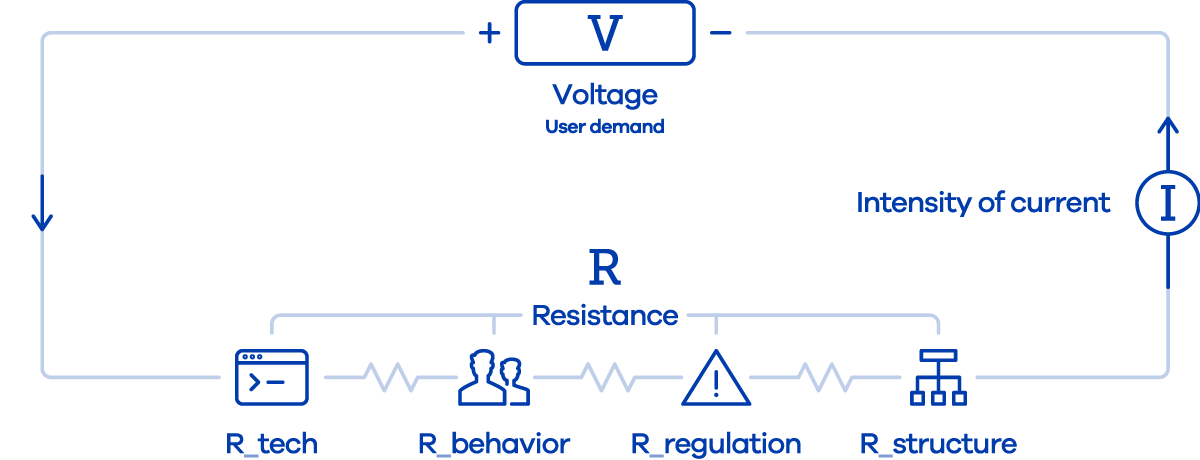
The idea behind Ignition iO is simple. Borrowing from Ohm's law (I = V / R), we look at markets as electric circuits.

A market drawn as an electric circuit: voltage V (user demand) flows through four types of resistance R (tech, behavior, regulation, structure) into current I

Strong demand (V), latent or visible, exists in most markets at almost all times. Investment debates tend to shine their light on the size of that demand. But when demand exists and the market still has not risen, what deserves the look is what is damming it up. We believe the essence of reading a market is decoding the structure of its resistance (R).

We classify that resistance into four types. Technical Resistance — the technology is immature, or the cost too high to be practical. Regulatory Resistance — laws and institutions do not permit entry or delivery. Behavioral Resistance — people and organizations do not change their habits. And Structural Resistance — those who lose from change hold the structure of the industry.

Here is the model at work — through Timee, one of our representative portfolio companies, and the spot-work market it opened.

VVoltage|strength of demand

"Short-staffed, just for today" and "I want to work my spare hours" — pressure building on both sides

On the hiring side, restaurants, retail, and logistics sites chronically ran short of hands for just a few hours today. On the working side were students, parents, and freelancers who wanted to work their spare hours — in large numbers. As the working-age population shrinks, this pressure keeps building. We call this strength of demand the voltage (V).

RResistance|what dams demand from surfacing and monetizing

The long-standing custom that employment requires a resume and an interview

Writing a resume and sitting an interview for a few hours of work pays off for no one (behavioral and structural resistance). The technology to run identity checks, attendance, and same-day pay at low cost did not exist (technical resistance). And day-labor dispatch was banned in principle (regulatory resistance). With several resistances stacked, "a few hours today" long failed to become a market.

ICurrent|strength of opportunity, momentum of the market

A market where "a few hours today" trades without interviews — the invention of spot work

Smartphones made matching, identity checks, attendance, and same-day pay complete inside an app (technical and behavioral resistance falling). As side jobs were liberalized, assumptions about work changed (regulatory and behavioral resistance falling). Timee turned the market's structural resistance into growth drivers again and again — and six years after its 2018 launch, made a major listing on the Tokyo Stock Exchange Growth Market in 2024.

The larger a resistance is, the more it gets treated as a given constant. In reality, it can fall discontinuously — through legal reform, technical progress, or generational turnover. When a structural resistance falls, demand that had been held back surfaces as if a dam had broken. What we track are the triggers of that change: the moments R comes down.

Matrix

When does the structural resistance (R) damming each market come down?

Rows list the industries; columns show the state of resistance in four categories (on mobile, both stack vertically). Solid cards are facts, dashed cards are hypotheses. Tap a resistance badge to read what each type means.

How to read this matrix:··
Solid = established factsDashed = hypotheses│ Now 2026.9
Criteria

Three checkpoints — our criteria for listing a card

These three are the listing criteria for the business ideas Ignition Compass sets out to conceive and co-create.

1

Is the demand large enough, and does it recur?

Is the market, or the social cost, large enough? Does the demand repeat rather than strike once? If law or policy generates it every year, the foundation is stronger still.

2

Which resistance falls, and why now?

Can you name the resistance? Can you show the grounds and timing of its fall with dated facts? If several independent drivers are working on it at once, the read gains confidence.

3

Does the opening turn into revenue?

Demand and a falling resistance only show the market is opening; they don't guarantee money flows. The third thing we check is whether the opening actually turns into payment — revenue for a business. We look for money moving at a business scale: a real budget or a new reason to pay, not just a latent need.

Few ideas bring all three together. So if you find a seed that might, we'd love to talk it through — half-baked, or just a hunch, is welcome. We hope Ignition Compass becomes a “change point” for founders and researchers: a place from which to launch, or set out to build, something big.