The Conviction That Innovation Can Be Made a Science – On the Renewal of Market iO
One of the topics on which founders and venture capitalists rarely manage to fully see eye to eye is the question of market size.
At Genesia Ventures, we have spent the better part of the last four years building and refining an internal framework called Market iO — a tool purpose-built to add depth, structure, and shared vocabulary to a concept that has long resisted systematic articulation, and to strip it of the ambiguity and personality-dependence that so often surround it.
With Market iO now undergoing a full-scale renewal — the new format went live in mid-May 2026 — I want to take this opportunity to set down, once more, the intent behind it, the path that brought us here, and the role this renewed version of Market iO will play within the broader investment operation of Genesia Ventures, a seed-stage VC operating across four Asian markets.
What Sparked the First Release of Market iO
The Meaning Encoded in the Name
Take Market — the word itself — and append the I/O familiar to anyone in software (short for Input/Output), wrapped in the io suffix so often worn by technology companies. The name is meant to evoke a single image: feed a startup’s business idea into market hypotheses-as-templates, and watch it come back out as something more dimensional, more expansive. An input transformed into an output of greater magnitude.
That is precisely why the lowercase i and uppercase O were chosen — to signal, even at the level of typography, that what comes out should be larger than what went in.
Why Now, and How We Are Rebuilding It
The original Market iO was a framework that carved any given market into eight archetypes, derived from three variables: the width of the river, the number of boats, and the speed of the current. Over four years of use, it has, I believe, done meaningful work — giving a notoriously slippery concept a shared vocabulary, and lifting the resolution of our internal debates by a notch.
And yet, as we kept using it, we found ourselves confronting a limit baked into the very design. The eight archetypes are, at the end of the day, snapshots of a finished result — a way of statically classifying landscapes that have already taken their shape, or are taking it. What the framework could not quite reach was the layer beneath that result: why a market has come to look the way it does, and how it might change from here.
For a seed investor, the real work lies in calling the timing of markets that will arrive — discerning when, and indeed whether, they will truly come. To catch the inevitable change earlier than anyone else. And yet, a bet placed too early is, in the end, a bet that misses. The fate of a seed VC hangs on finding that exquisitely narrow window in between. Measured against that standard, the original Market iO — to put it plainly — was not quite the tool to support the work we most wanted to do: calibrating the optimal moment of entry.
And so, with this renewal, we have moved our vantage point one step upstream. Rather than classify the current shape of a market, the renewed framework asks us to identify the forces that are moving that market (or holding it back), and the drivers (or release levers) behind them. What is generating demand? What is damming it up? And when, and by what, might that dam be broken? We have redesigned the tool to capture the structure behind a market with far higher resolution than before.
From Rivers and Boats to Electrical Circuits
Concretely, we have replaced the river-and-boat analogy of the original with the metaphor of an electrical circuit.
In the renewed Market iO, any given market is read as a circuit. Voltage (V) is the intensity of user demand generated within that market. Resistance (R) is the collective term for whatever impedes the flow of that demand. From the interplay of voltage and resistance, we estimate the business momentum that the market will produce — that is, current (I). That is the basic premise.
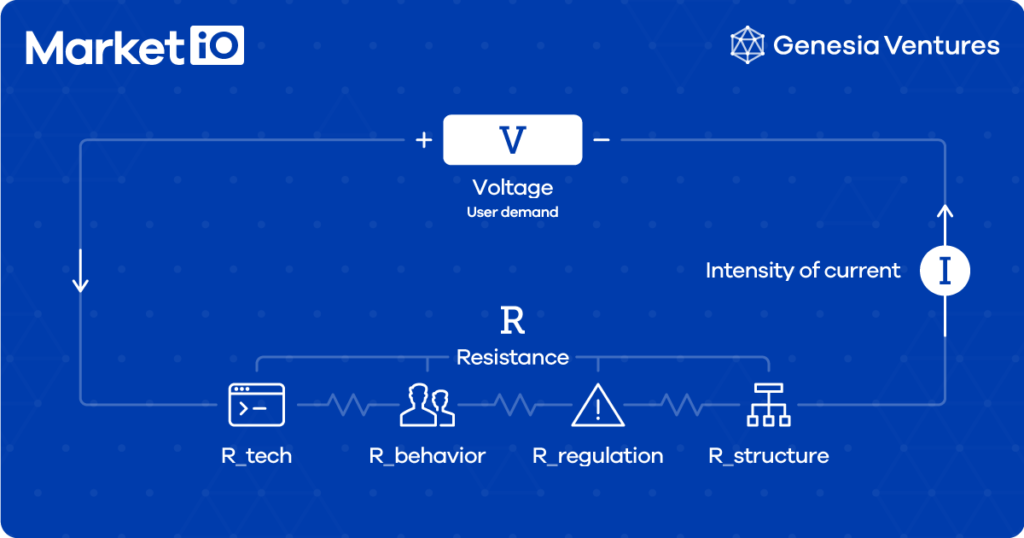
The point of the analogy is that resistance is not treated as a single, undifferentiated category. We decompose it into four distinct kinds:
- R_tech (technological resistance): barriers to entry rooted in technical constraints.
- R_behavior (behavioral / habitual resistance): the difficulty of changing user behavior.
- R_regulation (regulatory / institutional resistance): constraints imposed by law, licensing, and the like.
- R_structure (structural / incumbent-interest resistance): the structural advantages of incumbents, and the dams that keep latent demand from surfacing.
What proves genuinely useful on the seed investment floor is not the binary question of “is resistance high or low?” It is the sharper question: “which kind of resistance, when, and by what, will be released?” The renewed Market iO is designed so that every member of the team can hold and discuss that question in the same language.
And when one steps back to look at resistance in full, a further pattern emerges: the investment hypotheses behind a given business fall, broadly, into two types. The first is the demand-led (V-type) hypothesis, in which the central mandate is to amplify the market’s voltage itself. The second is the resistance-removal (R-type) hypothesis: demand has already risen, but some bottleneck is damming the flow (internally, we name and excavate this as the “Primary R”), and once that dam is removed, the flow surges into place.
Neither type is intrinsically superior. But making it explicit, at the point of investment, which kind of victory a given business is built to win, has a way of clarifying — almost on its own — which levers the team should converge on after the investment, and which indicators we, as their partner, should be watching alongside them. Market iO is, among other things, a guide rail for that act of thinking.
Toward an OS That Runs Across the Whole of a Seed VC’s Operation
There is one more ambition wrapped into this renewal that I cannot leave unspoken.
In parallel with Market iO, we are building Ideation iO — an AI-powered engine of our own design, dedicated to generating original business ideas.
Ideation iO is a system for proactively sourcing and incubating promising business ideas, drawing on the vantage point that comes from having roots in four Asian markets. It works through patterns such as “X for Y” — assessing the prospects of a local business rising in one country if transplanted to another — and “Glocal,” in which globally minded businesses are conceived from the comparative advantages that only a firm rooted in each of these markets can perceive. By weaving together primary intelligence gathered across our Asian markets with AI-driven inference, we mean to extract and cultivate these ideas at scale. And the foundation Ideation iO rests upon is, precisely, the renewed Market iO.
The most consequential difference from the original Market iO is this: where the old version lived primarily inside the investment memo at the deal-evaluation stage (as the new version still does), the renewed Market iO now carries the same information — the Primary R, the levers that will dislodge it, the timeline we expect — at the same level of granularity, into the post-investment journey.
Because we share a common eye for reading the world in terms of voltage and resistance, we can size up business ideas that have not yet entered the world at the same resolution. And once one of those ideas advances into investment evaluation, the same frame carries us — without disruption — from evaluation through the work of growing the company after we invest. Sourcing, evaluation, deal execution, post-investment partnership — stages that had until now been threaded together in separate formats and separate protocols — can be run through on a single shared language. The renewed Market iO is meant to function as the operating system that runs across the entirety of Genesia Ventures’ investment operation.
How It Is Actually Used
Abstractions only carry so far, so let me sketch what this looks like inside a live investment evaluation.
Consider, by way of example, a hypothetical AI-driven enzyme engineering startup called EnzymeForge — a company designing bespoke industrial enzymes from the ground up. Across plastic degradation, textile finishing, food processing, and beyond, the demand for enzymes that catalyze precisely the reaction one wants, under precisely the conditions one needs, plainly exists. The voltage (V), in other words, has already been there. And yet, until very recently, the design of new enzymes has been an undertaking that could only really be carried out inside the central research laboratories of a handful of large chemical incumbents.
The question of why that is — which is exactly where the four-fold taxonomy of resistance, and in particular the concept of Primary R, earns its keep. (We use Primary R to mean the single most stubborn bottleneck among all the resistances suppressing latent demand or blocking monetization — the one most tightly correlated with whether a venture clears its zero-to-one and whether it can keep compounding from there.) For this business, the Primary R is unmistakably R_structure — structural / incumbent-interest resistance. The number of possible amino-acid sequences that could constitute an enzyme runs into the astronomical, and only a vanishing fraction of them actually functions. The historical playbook had no choice but to lean on the intuition of seasoned researchers to narrow the candidate set, and then verify each one in the wet lab, one at a time. The search space was simply too vast for human-centered R&D to traverse at all — and that, structurally, is the dam that has long lain across this field.
Why, then, can that dam be broken now? Because the rise of LLMs has brought AI models that predict the three-dimensional structure of proteins with practical accuracy, and the technologies for inferring function from sequence have matured at striking speed. EnzymeForge would design a loop: the prediction model narrows the candidate sequences by a factor of thousands; the surviving candidates are validated in automated experimental facilities; the resulting data is fed back into the model to sharpen it further. A lever capable of dramatically lowering the cost of searching amino-acid space has, at last, entered the field — and that is why we read the moment as ripe.
For what it is worth, in the post-investment journey, the indicators we would track over time — the indicators that map directly to how quickly the R is being peeled back — would be the cycle time from candidate narrowing to functional confirmation per design theme, the improvement curve of the prediction model’s accuracy, and the number of adjacent application domains the technology successfully expands into.
To Make a Science of Innovation, and to Be the First to Believe in Those Who Carry It Out
In an age where dramatic change is breaking out, all at once, on every front, we have chosen, deliberately, to make change itself an object of scientific inquiry. To grow at ease with uncertainty, to take pleasure in risk, and yet to remain — relentlessly — faithful to structure and to cause. To treat innovation not as art but as science. Market iO and Ideation iO are, all of them, expressions of that posture.
What we are reaching for, through this whole body of work, is the ability to produce repeatable investment outcomes across Asia, continuously, over time. Not by leaning on the idiosyncrasies of any one person, and not by handing the work off to AI either. We will hold a common language for reading the factors that move a market at high resolution, run a single operating system from sourcing through partnership, and keep sharpening it. This renewal of Market iO is the first step of that.
Genesia Ventures will go on studying — with as much care, and as much daring, as anyone — the changes from which innovation springs. And we mean to remain the ones who believe, earlier than anyone else, in the founders who bring those changes into being.