Beyond Price Competition: KAMEREO’s Growth Strategy in Vietnam’s B2B Market
As part of Genesia Ventures’ Vietnam team, we regularly host events aimed at knowledge-sharing and building connections among our portfolio founders and aspiring entrepreneurs in Vietnam. We see our role as a cross-border venture capital firm that not only invests but also supports founders in building and scaling their businesses.
This report is the second in our event recap series.
- Read the first report here: “Building Trust to Win in the Local B2B Market: Lessons from Wareflex’s Founder”
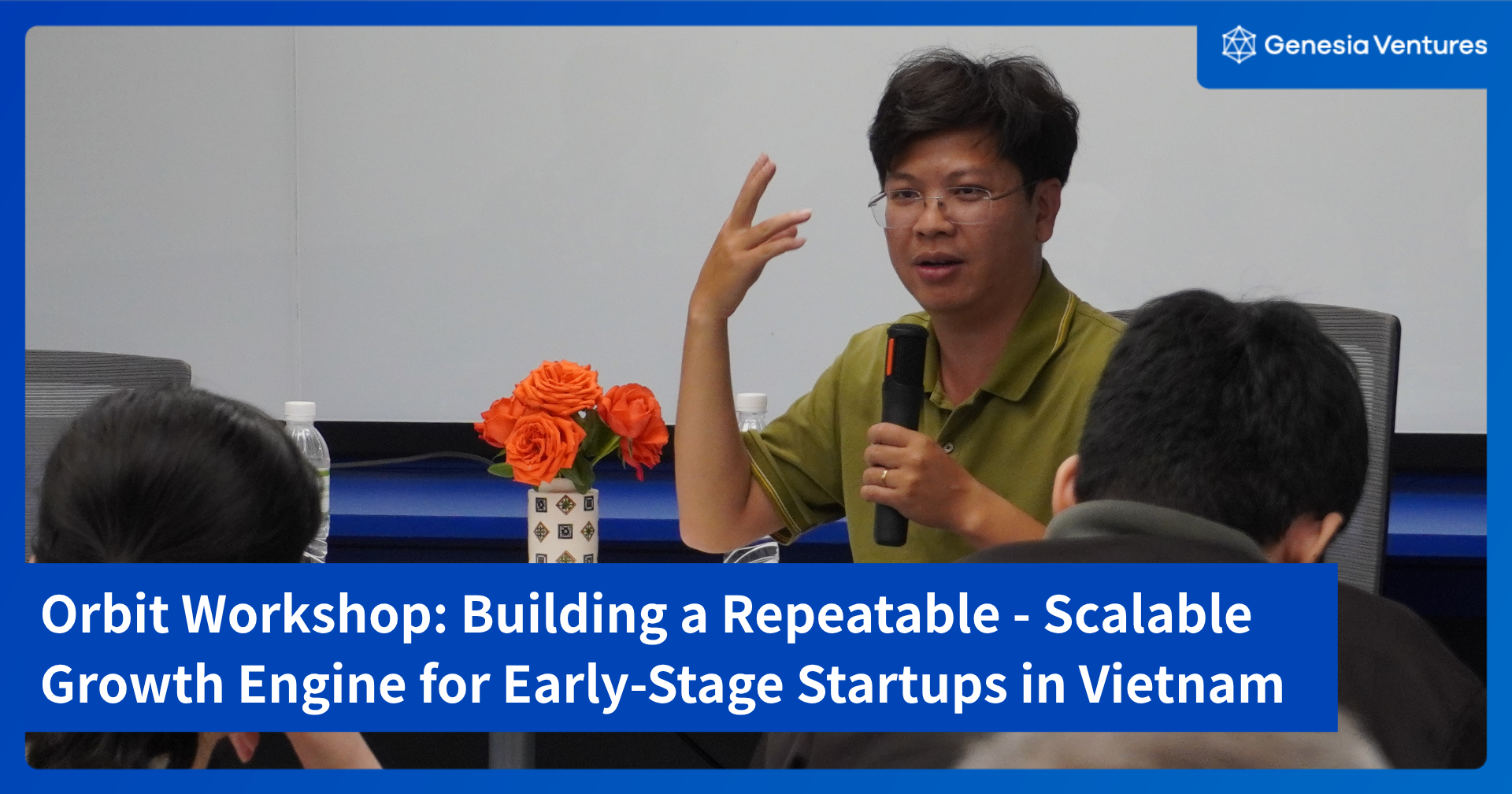
In this article, we bring you highlights from a fireside chat with Taku Tanaka, CEO of KAMEREO, Vietnam’s largest B2B food sourcing platform. Leading a sales organization of hundreds in a fast-growing market, Taku shared his perspectives on differentiation strategies in a highly price-sensitive market, building a culture-fit team, and making decisive choices as a founder navigating Vietnam’s B2B landscape.
- Moderator: Hoàng Thị Kim Dzung, Country Director of Vietnam, Genesia Ventures
- Editor: Vo Thanh Truc, Operation and Community Manager, Genesia Ventures
Core Value: A One-Stop Solution to Complex Customer Needs
Zun: KAMEREO provides a sourcing platform for restaurants in Vietnam. Could you start by sharing your core value proposition and how you meet customer expectations?
Taku: Our pitch to customers is simple. Restaurants need to order a wide variety of food and supplies every day. We aim to be the one-stop platform that fulfills these needs. With KAMEREO, they don’t have to deal with multiple suppliers—everything can be ordered in one place, with reliable on-time delivery. In essence, our core value is the combination of multiple values we deliver together.
Differentiating in a Price-Sensitive Market: Start with Customer Pain Points
Zun: In an emerging market like Vietnam, many assume “price is everything.” Did you face challenges with price sensitivity in the early days?
Taku: In highly price-sensitive markets like Vietnam, focusing only on price is a losing game. Of course, we do everything possible to optimize our supply chain and keep costs down. But I always tell my team, “Price is just one factor of success—never the only one.” If price alone decides the outcome, then we wouldn’t even need salespeople. The key is to show customers the unique core values that set us apart.
That’s why I tell my team: “Never lead with the price list.” If you start with price, the conversation inevitably turns to “you’re more expensive than others.” But not all products are the same—Chinese cabbage and Vietnamese cabbage don’t come at the same cost. We first need to listen to the customer’s pain points, identify the problems, and explain how we solve them. For example, some suppliers don’t issue legal invoices—we do. Or, managing multiple suppliers is a hassle—we handle that. That’s why we emphasize: don’t start with price.

Long-Tail B2B Strategy in Vietnam: Winning Through Timing
Zun: When building a sales organization, what do you focus on most?
Taku: It’s a constant process—running, identifying problems, fixing them, and repeating. There’s no finish line. A big difference compared to Japan or Korea is market size. Japan has giants like TOYOTA and HONDA, Korea has Samsung and LG. Vietnam’s largest groups, like Vingroup, are still relatively small. That means targeting just a few large corporates won’t get you to a billion-dollar business. To reach that scale, you need to penetrate the long-tail of SMEs and even micro-businesses. That requires a large sales force to reach them individually.
Regarding the advantage, If a small customer succeeds, they might open 10–20 stores a year, rapidly increasing revenue per account. This is a unique benefit of fast-growing markets. The B2B market is still small here, but that’s why big players hesitate to enter. It gives startups like us room to build the foundation and capture market share. Timing is everything: move too late, and it’s tough to compete with larger players.
Steering a Fast-Growing Organization: Designing Culture from Day One
Zun: You’ve highlighted long-tail sales and growing alongside customers. What has been your priority when building such a sales organization?
Taku: In Japan or Korea, labor is expensive and hiring is tough, so even Series B/C companies often have fewer than 100 employees. In Vietnam, however, it’s common for headcount to jump from 100 to 400–500 after Series C. Managing this rapid growth is the real challenge. That’s why the most important thing is to establish the right culture from Day One. You need to clearly define your core values, the kind of people you want to keep, and the kind you must let go. Without cultural alignment, the company breaks down. In Vietnam, if you want to build a large-scale company, you can’t wait until later—you must design culture from the start.

Hiring for Culture Fit: No Compromise on Values
Zun: Could you share some challenges and lessons learned in hiring and onboarding?
Taku: No matter how many interviews or trial periods you do, it’s hard to judge true value alignment. That’s why it’s critical not to compromise. Many leaders think, “We’re short on manpower, so let’s just hire someone for now.” But it rarely works out. Hiring the wrong person creates huge costs and effort to fix later. If you’re unsure, it’s better not to hire.
Still, mistakes happen. When a mismatch becomes clear, you must let that person go quickly. It’s not an easy call, but it’s the role of a founder. You might fear overburdening the rest of the team, but often things actually improve once you make the tough decision. It’s one of the most important, decisive acts in leadership.
Motivating Sales Teams: Balancing Monetary and Non-Monetary Rewards
Zun: Evaluation and incentives are also key in managing sales teams. What KPIs do you prioritize?
Taku: The ultimate KPI is sales. Of course, we break it down into new sales, existing sales, number of orders, order size, retention, etc. But at the end of the day, it’s about each person’s, each team’s, and the company’s total sales. From there, we analyze results against targets, past performance, and competitors, and design improvement steps accordingly.

Zun: And how do you design incentives around those KPIs?
Taku: Incentive structures vary by team—monthly, quarterly, or annually—but we use a base salary plus performance-based bonuses. Still, I don’t want people working only for money. If that’s the sole motivation, they’ll leave the moment they get a better offer. I want people aligned with KAMEREO’s mission, enjoying the work, and growing with us.
Especially younger talent today—they aren’t motivated just by money. They want connection, fun, and growth opportunities. So we focus on providing learning, networking, and personal growth opportunities alongside financial incentives. Since people spend eight hours a day here, the work itself and the sense of growing with peers are what make it meaningful. We’re still improving, but non-monetary incentives are especially important.
Building a Continuous Improvement Mindset
Zun: I hear KAMEREO also invests in training employees to shift their mindset toward continuous improvement. Could you tell us more?
Taku: Honestly, we didn’t emphasize training enough in the past. But now, we’re steering in that direction. Effective training requires flexibility—if someone refuses to embrace new ideas, you can’t really develop them. That’s why we’ve been hiring more young people and focusing not just on skills but also on mindset education. It starts with hiring people with the right mindset, then continuously reinforcing it through training.

Conclusion: Keys to Scaling in Vietnam’s B2B Market
From Taku’s talk, several critical insights emerged: the importance of timing in fast-growing markets, strategies to avoid price competition, the need to penetrate long-tail B2B customers, and the crucial role of culture in scaling organizations.
What stood out most was his philosophy of making swift, uncompromising decisions. Whether in hiring, incentive design, or culture, scaling an organization of hundreds demands clarity and decisiveness. For founders building in emerging markets like Vietnam, success often hinges on having a clear cultural foundation from Day One.
Note: This report reflects information as of August 22, 2025.