What Makes an Attractive Startup Organization? An Investor’s Perspective Through the VORAS Framework
This report is part of our Orbit Workshop series, spotlighting key insights from leading investors and operators across our network.
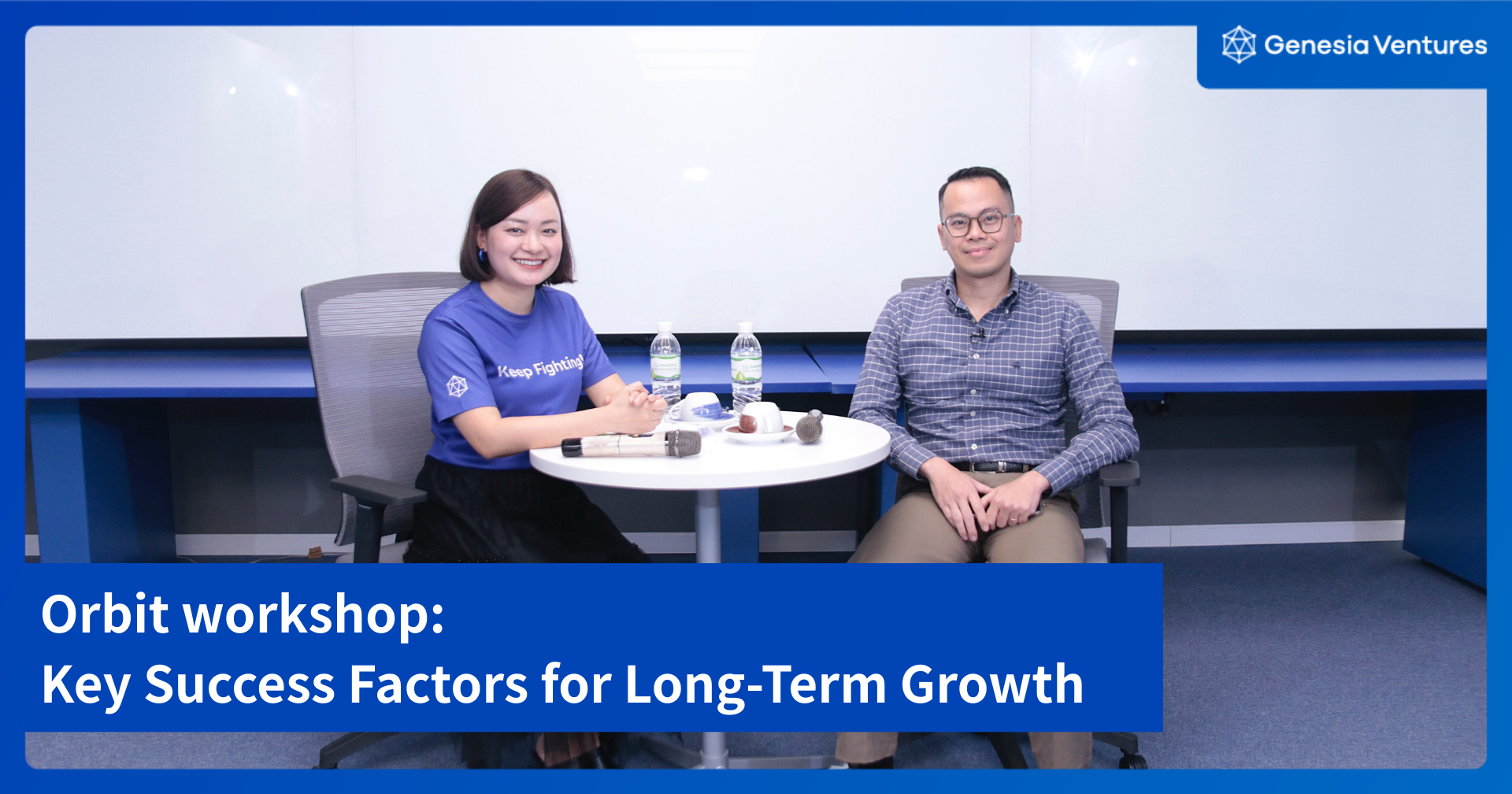
On November 28, 2025, we hosted Orbit Workshop: Key Success Factors for Long-Term Growth: Building Strong Organizations for Startups in Vietnam. The session was moderated by Hoang Thi Kim Dzung (Zun), Country Director of Genesia Ventures Vietnam, and featured guest speakers Taku Tanaka (Founder & CEO, KAMEREO) and Quang Pham (Investment Committee, ABB Private Equity).
Founders gained practical insights on building organizations that can grow sustainably. The discussion emphasized leadership discipline, governance systems, team culture, trust, and long-term alignment between founders and investors.
- Moderator: Hoàng Thị Kim Dzung, Country Director of Vietnam, Genesia Ventures
- Editor: Vo Thanh Truc, Operation and Community Manager, Genesia Ventures
For investors, strong organizational fundamentals begin with value, timing, and the ability to execute—not just people.
Zun: From an investor’s perspective, when you first meet a company, what are the most important signals you look for to assess whether it has strong organizational fundamentals?
Quang: Before answering directly, let me share how I usually think about investments. I’m quite an old-school investor. The first thing I always look at is whether the business represents a valuable asset—am I buying it at the right price, with a margin of safety, and at the right time?
Timing is critical. Even a great asset with great people will struggle if the timing is wrong. Timing is shaped by many factors—industry cycles, macro trends, and sector dynamics.
After value and timing, I look at scalability, then differentiation, followed by whether the playbook is defensibleagainst competitors and new entrants. Finally, the most important organizational signal is whether the company is executable.

Execution is the true test of organizational strength, separating good ideas from real businesses.
Quang: Execution is a broad concept. Today, it’s very easy to create beautiful pitch decks, articulate pain points, and present polished solutions—especially with AI tools. Business plans often look perfect on paper.
But execution depends on people, systems, processes, leadership, and discipline. This is where many companies fall short. When I evaluate execution, I inevitably come back to one core factor: leadership.
Leadership is not just about teams—it is about synchronizing movement across the entire organization.
Zun: From my perspective, leadership is about empowering a strong team that can execute together, building trust, and aligning vision, mission, and goals so everyone moves in the same direction.
Quang: That’s a good definition, and I’d like to simplify it further. Leadership is about movement—movement of people, systems, strategies, plans, KPIs, and actions.
Movement requires synchronization. You can have a great team, but if the strategy is wrong, resources are insufficient, or systems are misaligned, leadership fails—and so does the organization. True leadership is the ability to lead synchronized movement toward a shared vision.
Vision gives organizations emotional glue—it aligns founders, teams, partners, and stakeholders.
Zun: What founder qualities consistently correlate with long-term company growth?
Quang: I really resonated with Taku’s earlier sharing. He is both highly visionary and deeply detail-oriented—a rare combination. I use a framework I call VORAS to evaluate founders.
“V” stands for Vision. Vision is not a slogan like “becoming the largest company by 2030.” It must contain aspiration and emotion. Vision explains why the company exists and serves as glue that binds founders, employees, families, shareholders, customers, and suppliers together.
Take Starbucks, for example. “The third place” is a simple but powerful vision—it carries ambition, emotion, and pride.
A strong vision often starts as a belief before it becomes a profitable business model.
Quang: Let me share a real example. I was an early investor in a cinema chain in Vietnam—just months after its first cinema opened. There was no proper P&L, no proven track record.
When I asked the founder about his vision, he said he wanted to bring affordable entertainment to young people in rural areas, offering healthier alternatives to nightlife options available at the time. That vision guided the company’s decisions—even before it became a formal statement.
Today, Vietnamese films account for nearly half of the country’s box office revenue. That didn’t happen overnight—it started with vision and resilience.

Resilience and adaptability are not opposites—they must coexist for long-term survival.
Quang: In VORAS, after Vision comes Operations excellence, then Resilience and Adaptability. These two may sound contradictory, but they are not.
We live in a rapidly changing world—AI, geopolitical shifts, regional asset reallocations. Founders must be resilient enough to endure hardship, yet adaptable enough to evolve with global and regional transformations. Southeast Asia, including Vietnam, is undergoing massive structural change, and founders must adapt accordingly.
Simplicity and honesty are underrated leadership strengths that drive productivity and trust.
Quang: The final two elements are Simplicity and Honesty. Many organizations overcomplicate their structures unnecessarily. Simplicity drives productivity and effectiveness.
Honesty, meanwhile, underpins everything. Without honesty, no system, process, or governance structure can function sustainably.
Governance is not bureaucracy—it is a leadership tool to build trust.
Zun: Governance is still underemphasized in Vietnam’s startup ecosystem. Why does governance matter so much from a PE perspective?
Quang: Governance is fundamentally about trust. Capital raising is storytelling and trust-building; investing is buying into that story. Governance provides structure for trust.
Money is one of the hardest things to obtain, and trust is the only way to access it. Governance signals to investors that the company is serious, disciplined, and accountable.

For early-stage startups, governance starts with mindset—not expensive systems.
Zun: For early-stage founders with limited resources, what is the most practical way to implement governance?
Quang: Investors don’t expect perfection. They look for mindset and intent. Just like banks evaluate willingness to repay, investors assess whether founders are moving toward better governance—even if systems are still basic.
If founders demonstrate commitment, investors are often willing to help elevate governance standards over time.
Alignment with investors requires understanding their incentives, timelines, and constraints.
Zun: How can founders better align with investors when making difficult growth decisions?
Quang: Alignment starts with understanding your investor. Funds differ vastly in timelines, exit pressures, and strategies. Founders often approach fundraising only when they urgently need money—this weakens their negotiating position.
Instead, founders should engage early, build relationships, and understand the fund’s lifecycle. Alignment improves when founders create strategic positioning rather than negotiating from urgency.
Exit attractiveness depends on building an organization that fits the next buyer—not everyone.
Zun: From a PE perspective, what organizational factors make Vietnamese companies more attractive for exit?
Quang: Historically, international buyers have invested in Vietnam for growth and market access. Companies with strong distribution networks, execution capability, and market coverage are highly attractive.
Systems like ERP can be imported—but local execution capability cannot. Organizations that design their people, systems, and processes to meet buyer needs are far more likely to achieve successful exits.

Summary
Mr. Quang’s talk shared numerous critical insights from an investor’s perspective. Building a strong organizational foundation requires a clear vision and “execution capability.” A founder’s leadership is the ability to synchronize the organization’s “movements,” and it is honed through a balance of resilience and adaptability, simplicity and sincerity. Governance is a vital tool for building trust and achieving long-term alignment with investors. Strengthening these organizational elements will be the key for Vietnamese startups to create more attractive exit opportunities.
Note: This report reflects information as of January 20, 2026.